Every era of basketball has its argument about the greatest player of all time. Bill Russell's case is the simplest one ever made: he won. Not occasionally, not in a short burst, but almost every year for thirteen seasons. Eleven NBA championships with the Boston Celtics. Two college titles before that, and an Olympic gold medal in between. No other player in a major American team sport has won so consistently at the highest level.
Russell's greatness is hard to capture in a box score — partly because the statistics that best described his impact were not even recorded in his day. To understand him, you have to look at what happened to every team he joined.
Before Boston
Russell was born in West Monroe, Louisiana, in 1934, and grew up in Oakland, California, after his family moved west. He was not an instant prodigy. He was cut from teams, struggled with fundamentals and only began to stand out late in high school. What he had was a rare combination of size, speed, timing and an analytical mind that treated basketball as a problem to be solved.
At the University of San Francisco, the solution worked spectacularly. USF won the NCAA championship in 1955 and again in 1956, with Russell as the dominant force. That same year he won gold with the United States at the Melbourne Olympics, which delayed the start of his professional career.
The trade that built a dynasty
Celtics coach Red Auerbach was convinced that Russell was exactly what his team lacked. Boston already had elite guards in Bob Cousy and Bill Sharman, but no one to control the paint and start the fast break. In 1956, the Celtics traded two established players to the St. Louis Hawks for the rights to draft Russell.
The impact was immediate. Russell arrived partway through his rookie season after the Olympics, and Boston won the 1957 championship — the franchise's first.
Defense as offense
Russell changed the meaning of defense in basketball. Before him, big men often stayed near the basket and blocked shots by swatting them out of bounds. Russell blocked shots and kept them in play, tipping the ball to a teammate who could push it up the floor before the opponent could set up. A blocked shot became the first pass of a Celtics fast break.
He also mastered positioning and anticipation. Opponents changed their shots, hesitated or stopped driving altogether when he was on the floor. Blocked shots were not an official NBA statistic until 1973–74, after he retired, so his most famous skill left almost no numerical trace. Rebounds were tracked, and there his numbers were enormous: year after year he was among the league leaders, often pulling down more than twenty a game.
The run
After that first title in 1957, the Celtics lost the 1958 Finals — Russell was hampered by an ankle injury — and then won eight championships in a row, from 1959 through 1966. No team in the history of the major American professional leagues has matched that streak.
Russell's rivalry with Wilt Chamberlain defined the decade. Chamberlain was bigger, stronger and a far more prolific scorer, and he set records that still stand. But in head-to-head playoff series, Russell's Celtics almost always came out on top. To many fans, the comparison became a debate about what greatness means: overwhelming individual numbers, or a relentless ability to make a team win.
Along the way, Russell was named the league's Most Valuable Player five times — voted, at the time, by the players who had to play against him.
Player and coach
When Auerbach stepped down as coach after the 1966 title, he chose Russell to replace him while he continued to play. Russell became the first Black head coach in the NBA — and in any of the major American professional leagues.
His first season as player-coach ended without a title, as Chamberlain's Philadelphia 76ers broke through. Then the Celtics won again in 1968 and, with an aging roster that few expected to go far, once more in 1969. Russell retired after that season, leaving the game as a champion: eleven titles in thirteen seasons, the last two as both its leader on the floor and on the bench.
Beyond the court
Russell's life in Boston was not simple. He faced open racism in the city, including the vandalism of his home, and he spoke candidly about it at a time when many athletes stayed silent. He was active in the civil rights movement, attended the 1963 March on Washington and joined other Black athletes at the 1967 Cleveland Summit in support of Muhammad Ali's refusal to be drafted.
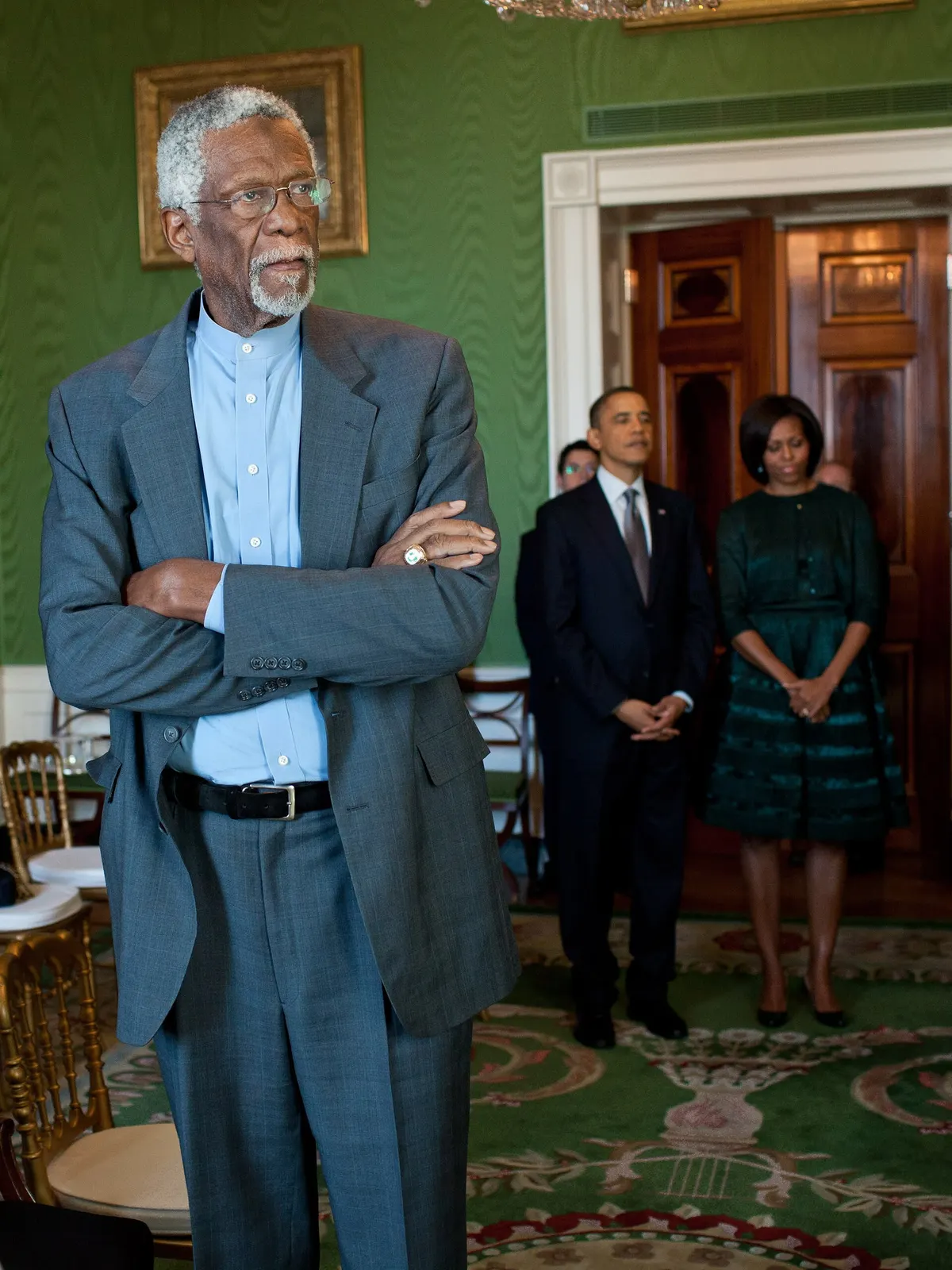
Recognition came later than it should have. In 2009, the NBA named its Finals MVP award after him. In 2011, he received the Presidential Medal of Freedom. When he died in July 2022, the league retired his No. 6 across every team — the first time the NBA had ever honored a player that way.
The measure of a player
Modern analytics have tried to estimate what Russell's defense was worth, and the estimates are invariably huge. But perhaps the most persuasive evidence is the simplest. His college team won two titles. His Olympic team won gold. His professional team won eleven championships in thirteen years.
Bill Russell did not need the numbers to prove his value. He needed only the standings.