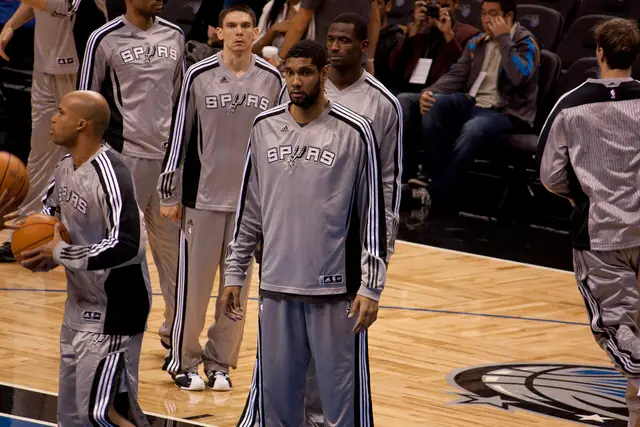
The final score was 78–77. On June 25, 1999, San Antonio finished Game 5 at Madison Square Garden one point ahead of New York and became NBA champion for the first time.
That narrow finish sits beside a much wider picture: the Spurs won fifteen of their seventeen playoff games. Both descriptions are true. Together, they make this title more interesting than either a story of effortless dominance or a single decisive shot.
Why 37 wins meant something different
A lockout delayed the regular season until February and reduced it to 50 games. San Antonio finished 37–13, taking the West's first seed. Tim Duncan was in his second NBA season; David Robinson was alongside him, with Gregg Popovich coaching.
Reading that record requires the right denominator. Thirty-seven wins out of fifty is a 74% winning percentage, calculated directly from the record. Comparing only the win total with a team that played 82 games would miss the season's defining constraint.
It is equally unhelpful to turn that percentage into wins in games that never happened. A longer schedule introduces opponents, travel and availability questions that this record cannot answer. The achievement belongs to the competition San Antonio actually played.
Fifteen wins, under the rules of 1999
The Spurs eliminated Minnesota 3–1, then swept the Lakers and Portland 4–0 each. The first round was best-of-five; the later rounds required four wins. Beating New York 4–1 completed a 15–2 postseason.
That total is not a missing victory. It follows the format: 3 + 4 + 4 + 4 = 15. Modern season guides describe a different first round, so apply the rules of the year when reading an older champion.
Even a sweep can contain a close escape. Against Portland in Game 2 of the conference finals, Sean Elliott's late three-pointer helped turn a game in which San Antonio had trailed by seventeen into an 86–85 victory. The series eventually reads 4–0; the game record preserves the difficulty inside it.
The opponent had its own route
New York arrived as the East's eighth seed after eliminating Miami, Atlanta and Indiana. Patrick Ewing missed the Finals through injury. The Knicks won Game 3, preventing a sweep, before San Antonio took the next two.
Seed and availability supply different kinds of context. Eighth describes New York's place in the regular-season field. It does not erase the three opponents the Knicks had already beaten. Ewing's absence describes the team San Antonio faced, without establishing how a hypothetical series with him would have ended.
A one-point finish inside a five-game series
In the clincher, Duncan scored 31 points and Latrell Sprewell scored 35 for New York. Avery Johnson's jumper put the Spurs ahead with 47 seconds remaining, a timing detail recorded in the NBA's season review.
Forty-seven seconds matters: this was a late go-ahead basket, not a shot at the final buzzer. The 78–77 result records the eventual outcome. Keeping those two moments separate lets the closing sequence retain its actual shape.
Duncan received Finals MVP. Johnson supplied the basket that changed the lead for the last time. Those facts answer different questions about the same championship: who received the series award, and whose shot settled the scoring. A useful account has room for both.
Read the first title before the dynasty
Looking backward can make a first championship feel like an inevitable opening chapter. In 1999 it was a completed achievement with a specific schedule, bracket and opponent. Those details deserve attention before later Spurs seasons enter the picture.
For the longer arc, open the San Antonio team dossier, then move to the 2013 and 2014 Finals against Miami. Compare the rosters and routes as well as the trophies. The exercise makes the passage of time visible instead of treating every championship as another copy of the first.