No team had ever done it. In more than seven decades of NBA Finals, a 3–1 series lead had always been enough. And in June 2016, the team holding that lead was not just any opponent — it was a Golden State Warriors side that had just finished the best regular season in league history.
What the Cleveland Cavaliers did next turned a near-certain coronation into one of the most remarkable comebacks in American sports.
The team that couldn't lose
The 2015–16 Warriors went 73–9, breaking the record of 72 wins set by the 1995–96 Chicago Bulls. Stephen Curry was named MVP for the second straight year, the first unanimous selection in the award's history. Golden State had beaten Cleveland in the previous year's Finals, when the Cavaliers were missing two of their best players to injury. This time Cleveland was healthy, but most observers still expected the Warriors to repeat.
For four games, that is exactly how it looked. Golden State won Game 4 in Cleveland to take a 3–1 lead, with a chance to close out the series at home.
The suspension
Game 4 also contained the moment that would later be seen as the turning point. Late in the game, Draymond Green tangled with LeBron James and swiped at him as James stepped over him. The league reviewed the play and assessed Green a flagrant foul. Because of the flagrant points he had already accumulated in the playoffs, that was enough to trigger an automatic suspension. Green, Golden State's emotional engine and one of its most versatile defenders, would miss Game 5.
Game 5: 41 and 41
With Green out, the Cavaliers went to Oakland facing elimination — and James and Kyrie Irving produced one of the great tandem performances in Finals history. Each scored 41 points. Irving was nearly flawless, slicing through the defense and finishing over taller players; James controlled everything else. The Warriors also lost center Andrew Bogut to a knee injury during the game, thinning their rotation for the rest of the series. Cleveland won, and the series returned to Ohio.
Game 6: another 41
Back home, James did it again: 41 points and a performance that included a chase-down block of Curry and an unmistakable message. Cleveland won Game 6 115–101, and for the first time in the series, the pressure shifted. The Warriors, the record-setters, now had to win one game at home to avoid becoming the first team to lose the Finals from a 3–1 lead.
Game 7: the last four minutes
Game 7 was played on Sunday, June 19, 2016 — Father's Day — in Oakland. It was tight, tense and, for long stretches, ugly in the way only elimination games can be. Neither team could pull away. With a little under five minutes left, the score was tied at 89, and points suddenly became almost impossible to find. Each possession felt heavier than the last.
The game was decided by three plays.
The block. With roughly two minutes left, Andre Iguodala raced out on a fast break with Curry alongside him. It looked like an easy layup that would put Golden State ahead. James sprinted the length of the floor and pinned Iguodala's shot against the backboard. The score stayed level. Replays made it look impossible; it has been replayed countless times since.
The shot. With under a minute remaining, Irving isolated against Curry on the right wing, stepped back and lifted a three-pointer over the MVP's outstretched hand. It went in. 92–89.
The stop. Golden State still had time. On the next possessions, Kevin Love — often criticized for his defense — found himself switched onto Curry on the perimeter. Love stayed in front of him, moving his feet through every fake, and Curry's three-point attempt missed. James then made one free throw after a hard fall on a dunk attempt, and Cleveland held on to win 93–89.
The numbers behind the comeback
James finished Game 7 with a triple-double. Across the series, he led both teams in points, rebounds, assists, steals and blocks — a statistical sweep that underlines how completely he carried the Cavaliers. He was named Finals MVP unanimously.
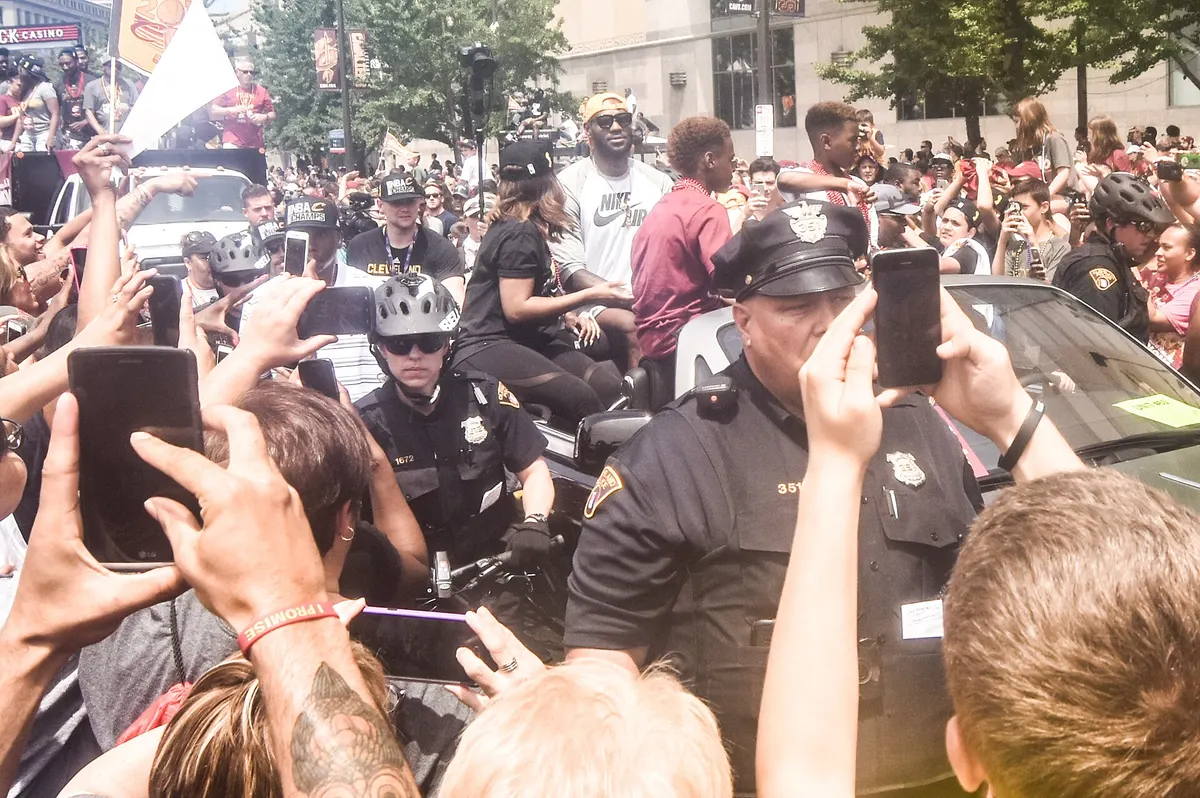
The win also ended one of the longest championship droughts in American sports. Cleveland had not won a title in any of the major professional leagues since the NFL's Browns in 1964 — a gap of 52 years. For James, an Akron native who had left Cleveland in 2010 and returned in 2014 promising to bring the city a championship, it was the fulfillment of a very public vow. Moments after the final buzzer, he shouted, through tears, "Cleveland, this is for you!"
The aftermath
The comeback reshaped the next several years of the NBA. That summer, Kevin Durant joined the Warriors, and Golden State beat Cleveland in the Finals in both 2017 and 2018. The 73–9 record still stands as the best regular season in league history, yet it will always come with an asterisk of sorts: the team that set it did not win the title.
For Cleveland, the details remain fixed in memory — the block, the shot, the stop. Three plays in the final two minutes of a seven-game series, and an entire city's history changed.